
 Posts
Posts


| ||||||||||||||||||||||||||||||||||||||
Saturday, November 2, 2013
Barry Cull is still waiting for you to join Twitter...





Saturday, October 19, 2013
Barry Cull is still waiting for you to join Twitter...
| ||||||||||||||||||||||||||||||||||||||
Saturday, October 12, 2013
Barry Cull is still waiting for you to join Twitter...
| ||||||||||||||||||||||||||||||||||||||

Tuesday, October 8, 2013
Barry Cull is still waiting for you to join Twitter...
| ||||||||||||||||||||||||||||||||||||||
Friday, October 4, 2013
Barry Cull sent you an invitation
| ||||||||||||||||||||||||||||||||||||||
Friday, April 6, 2012
Brewing a Great Beer VI
What better way to herald in the holiday weekend with a poker game/beer fest? The group of regulars to the monthly Thursday night poker game have been anticipating this keg of beer since I started the brew back on February 20, 2012. The evening provided an opportunity to get a rating of the beer using the American Homebrewer's Association score-sheet.
The AHA evaluates a beer across 5 dimensions: Bouquet/Aroma, Appearance, Flavour, Body and Drinkability Overall Impression. The resulting score is out of a total of 50 points.
The Judges:
The raters ranged in knowledge of beer styles from "I don't like beer, I prefer wine" and "I'm Dutch, I prefer lager" to very sophisticated, #...takes me back to the days of sharing a pint with me dad in Lancashire". Only myself and another member of the group have actually tasted White Shield on draught in its native country, England. In general though, this group will drink anything resembling beer, and there has only been one beer that I have brewed that people didn't like (except the Dutch guy) - a cherry lambic.
The Rating:
The average rating for the beer was: 40.5/50. This places the beer in the Excellent range according to the AHA Scoring Guide. To the credit of the style (UK IPA) people commented on the fruity aroma and taste, the good balance, the alcohol presence and the malty character. A few people noted that for the style, the beer lacked a full hop bite. Also, on the con side there was the presence of caramel in the aroma on initial pour. All-in-all, the beer was a fine English bitter that needed a little more hop character to be worthy of White Shield.
The AHA evaluates a beer across 5 dimensions: Bouquet/Aroma, Appearance, Flavour, Body and Drinkability Overall Impression. The resulting score is out of a total of 50 points.
The Judges:
The raters ranged in knowledge of beer styles from "I don't like beer, I prefer wine" and "I'm Dutch, I prefer lager" to very sophisticated, #...takes me back to the days of sharing a pint with me dad in Lancashire". Only myself and another member of the group have actually tasted White Shield on draught in its native country, England. In general though, this group will drink anything resembling beer, and there has only been one beer that I have brewed that people didn't like (except the Dutch guy) - a cherry lambic.
The Rating:
The average rating for the beer was: 40.5/50. This places the beer in the Excellent range according to the AHA Scoring Guide. To the credit of the style (UK IPA) people commented on the fruity aroma and taste, the good balance, the alcohol presence and the malty character. A few people noted that for the style, the beer lacked a full hop bite. Also, on the con side there was the presence of caramel in the aroma on initial pour. All-in-all, the beer was a fine English bitter that needed a little more hop character to be worthy of White Shield.
Wednesday, March 14, 2012
Brewing a Great Beer V

Conditioning
This weekend the secondary fermentation was completed! The "green" beer was siphoned into the conditioning keg and priming sugar was added to create the final level of carbonation. The siphoned beer ran crystal clear, with no trace of haze.
A test sample was taken and the final gravity for the beer was 1.018, which was slightly higher than the expected 1.017. The indication, then, is that fermentation was essentially completed. With these data, the estimated Alcohol by Volume (ABV) is expected to be 5.4%.
I had a chance to taste the test sample and was very pleased. If the conditioning goes well over the next couple of weeks this will be a mighty fine beer. The malt/hop balance was near perfect, with no "off" flavours interfering with the palate. This should be a beer worthy of serving to my poker buddies on April 5. Stay tuned for the final report after that date.
Sunday, February 26, 2012
Brewing a Great Beer IV

From Primary to Secondary
Today is the 4th day of the brew cycle and time to transfer the fermenting beer from the primary to the secondary fermenter. After sanitizing all the equipment a siphon is started and the new beer begins to flow.
For the past few days the brew has been at a constant 65 degrees F on the basement floor. There has been a lot of action and a couple of times the foaming mess overflowed the container. Fortunately, there was a pot underneath the fermenter to catch the overflow.
A test of the specific gravity showed 1.025 / 64 degrees. This mean that about 81% of the available fermentable sugars have been converted to alcohol by the yeast. There are still 19% of the sugars left to arrive at a final SG of 1.017. Current alcohol is estimated at 4.7% ABV.
Taste Test
I tasted the test sample to assess the
 quality of the brew at this point. I am happy to report that there are no off flavours. In fact, the beer tastes pretty good. There is a very agreeable malt/hop balance, with perhaps a little less bitterness than anticipated. Floral notes in the hops were quite evident. This is still early, of course, but the flavour is well within the profile parameters of the beer type (India Pale Ale).
Wednesday, February 22, 2012
Brewing a Great Beer III
Method
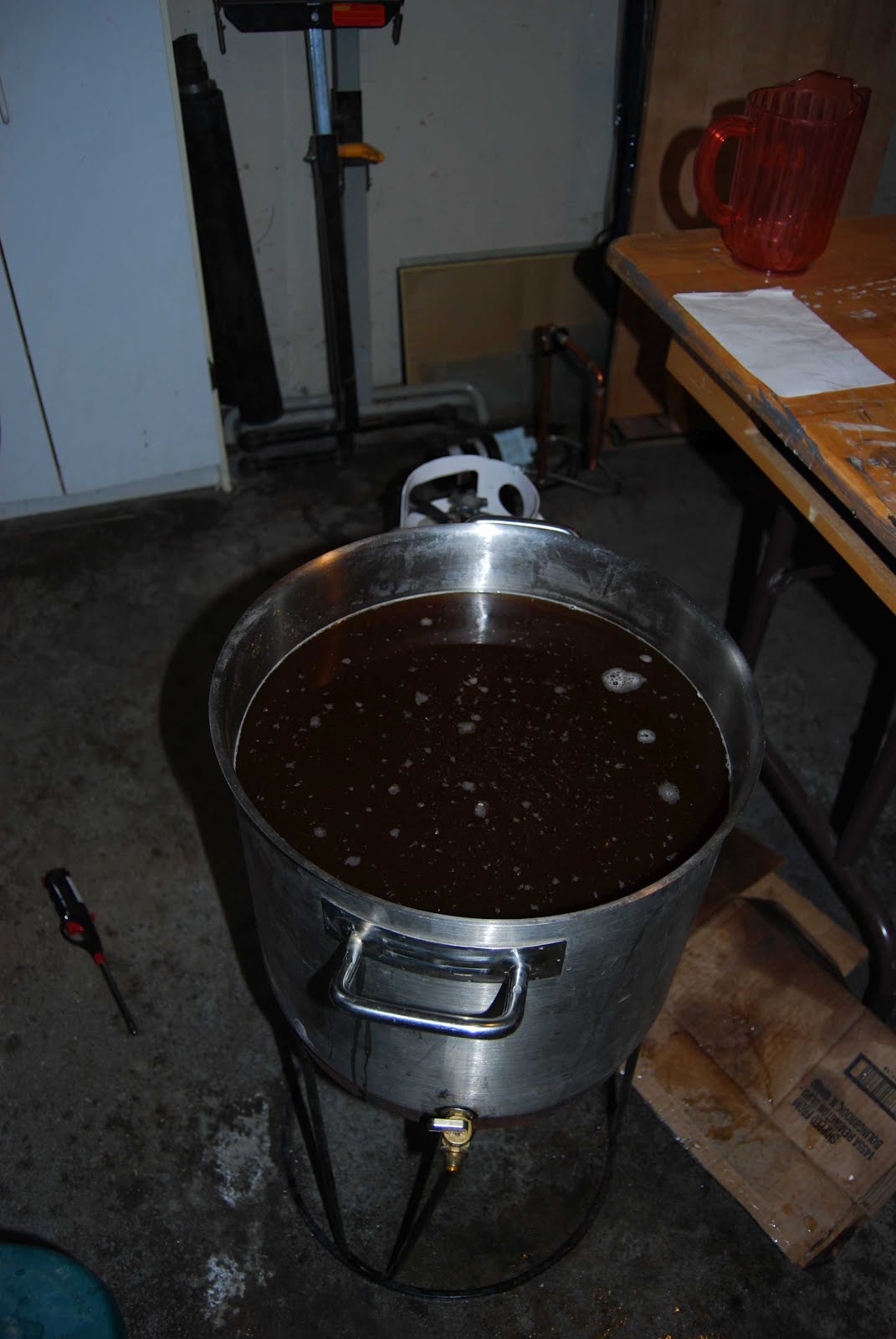
 For this brew method I used an 8.5 US gal. pot with a false bottom suspended 3 inches above the source of the heat. I filled the pot with approximately 5.5 gal. of cold water and brought to a temperature of 130 degrees F. I then filled the bag with the grains (see recipe) and stirred until temperature stabilized at 128 degrees. This temperature was held for 20 minutes.
The mash was heated to 156 degrees over 15 minutes. It was held at this temperature for 1 hour. The mash was then heated to 170 degrees over 22 minutes. Finally, the bag was raised out of the pot and rinsed with 170 degree water to 6 3/4 gals.
It took over an hour to raise the wort to boiling. In the process the wort was reduced to 6 gallons before the bittering hops were added. The wort was boiled for 45 minutes and the aroma hops were added. By this time there was just less than 5 gals. in the pot, which was topped with boiled water to bring it to 5 1/4 gals.
The wort was cooled quickly to 64 deg. F. using a reverse-flow cooler. After aeration the yeast was pitched. The SG was measured at 1.059 at 64 deg. F., resulting in a mash efficiency of 86%!
A note on the recirculating pump:
A pump was used at the outset to take the wort from the bottom of the pot and bring it to the top of the grains. While the outflow tube was submerged in the mash, a foam developed which led me to believe that hot-side aeration was occurring. I dismantled the pump set-up at this point and relied on frequent stirring instead.

Beer Profile After Adjusting for Efficiency
The profile after adjusting for the measured efficiency of the method is as follows:
SG 1.059
Bitterness 39.1 IBU
Colour 11.2 SRM
Est Alcohol by Volume 5.5%
This is wonderfully close to the specs for Worthington White Shield!
The batch is now fermenting at 65 deg F. in the primary fermenter.
 For this brew method I used an 8.5 US gal. pot with a false bottom suspended 3 inches above the source of the heat. I filled the pot with approximately 5.5 gal. of cold water and brought to a temperature of 130 degrees F. I then filled the bag with the grains (see recipe) and stirred until temperature stabilized at 128 degrees. This temperature was held for 20 minutes.
The mash was heated to 156 degrees over 15 minutes. It was held at this temperature for 1 hour. The mash was then heated to 170 degrees over 22 minutes. Finally, the bag was raised out
 of the pot and rinsed with 170 degree water to 6 3/4 gals.
It took over an hour to raise the wort to boiling. In the process the wort was reduced to 6 gallons before the bittering hops were added. The wort was boiled for 45 minutes and the aroma hops were added. By this time there was just less than 5 gals. in the
 pot, which was topped with boiled water to bring it to 5 1/4 gals.
The wort was cooled quickly to 64 deg. F. using a reverse-flow cooler. After aeration the yeast was pitched. The SG was measured at 1.059 at 64 deg. F., resulting in a mash efficiency of 86%!
A note on the recirculating pump:
A pump was used at the outset to take the wort from the bottom of the pot and bring it to the top of the grains. While the outflow tube was submerged in the mash, a foam developed which led me to believe that hot-side aeration was occurring. I dismantled the pump set-up at this point and relied on frequent stirring instead.
Beer Profile After Adjusting for Efficiency
The profile after adjusting for the measured efficiency of the method is as follows:
SG 1.059
Bitterness 39.1 IBU
Colour 11.2 SRM
Est Alcohol by Volume 5.5%
This is wonderfully close to the specs for Worthington White Shield!
The batch is now fermenting at 65 deg F. in the primary fermenter.
Tuesday, February 21, 2012
Brewing a Great Beer II

I have planned for tomorrow to be "brew day". There are still a few things that need to be done, however. I am using a set up, developed by Australian home brewers, that will apparently make brewing easier. The method is called brew in a bag (BIAB) and requires the grains to be steeped in a large bag, much like tea. Today's task is to rig a pulley system to handle the extrication of the hot and heavy bag full of wet grains.
 Last weekend I enlisted the help of family to sew up the bag needed to hold the grains. I also rigged up a pump system to recirculate the hot wort through the grains. I will be using a three-stage mash process with a final rinse at 168 degrees Farenheit.
Steps:
Protein rest - 125 degrees (20 min)
Saccharification - 156 degrees (60 min)
Mash Out - 168 degrees (10 min)
Monday, February 20, 2012
Brewing a Great Beer
 Worthington White Shield
When I was in England a few years back I visited the Bass Museum in Burton-on-Trent. While there I had, what I recall, was one of the best ales in my life. The museum brewed the Museum White Shield ale based on the old recipe developed by Worthington in the 19th century. The ale is a traditional India Pale Ale and became a major export for Worthington well into the 20th century. I had what would turn out to be one of the last pints to come out of the museum brewery.
A description of the beer follows:
White Shield (5.6%) is brewed from pale malt with a touch of crystal for colour and flavour. Its colour rating is 26, making it quiet dark for the style. The hops are Challenger, Fuggles and Northdown, which create 40 units of bitterness. Challenger and Fuggles are copper hops used for bitterness, with Northdown are added at the end of the boil for aroma. - taken from Beer Pages.comI adapted my recipe from Graham Wheeler and Roger Protz book "Brew Your Own British Real Ale", CAMRA/Storey Books, 1998. The recipe I used is reproduced here.
| Grains | |||||||
| 8 lbs 11.6 oz | Pale Malt (2 Row) UK | ||||||
| 1 lbs 4.7 oz | Caramel/Crystal Malt | ||||||
| Hops | |||||||
| 20.00 g | Challenger [7.50 %] - Boil 60.0 min | ||||||
| 15.00 g | Northdown [8.50 %] - Boil 60.0 min | ||||||
| 10.00 g | Northdown [8.50 %] - Boil 15.0 min | ||||||
| Yeast | |||||||
| 1.0 pkg | London Ale III (Wyeast Labs #1318) |
The resulting profile matches closely that described above, with bitterness at 42 IBU, colour at 11.6 SRM and alcohol by volume at 5.3%, (assuming 80% mash efficiency). (Estimates based on Beersmith brewing software.)
Grinding the Grain
Propagating the Yeast

Friday, March 11, 2011
AIDS Awareness Week
My daughter, Caitlin, gives an interview on a very important subject on CKLW AM in Windsor, ON.
Monday, February 28, 2011
Wednesday, February 23, 2011


Sunday, February 6, 2011
Snyder's Bush Ski Trails

Sent from my BlackBerry® wireless device
Sunday, September 26, 2010
The Mighty Thelon
July 22- July 25
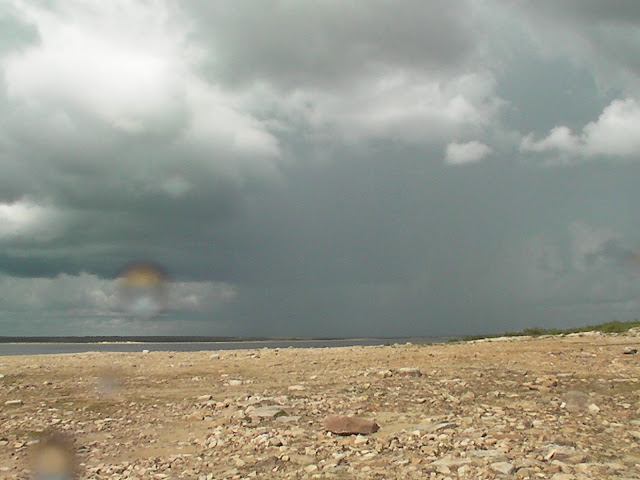
After our first full day on the Thelon River we had completed 187 kilometres, with 185 left to do. We were half way to our destination at Warden's Grove with 8 days left to our scheduled date of pick up. We had taken 10 days to get here, and we had to work very hard to make the progress we did. We were all concerned that if we encountered more difficult terrain, or if we ran into bad weather we would not make our destination in time.
Our fears were allayed to a large extent by the fact that over the next few days we made very good progress and the weather remained quite fair. In fact, over the next few days we travelled 133 kms., averaging 44 kms. per day. We managed to catch fish and had a feast of pike or trout each night.
The topography of the river in this section is dominated by sand eskers and sandstone canyons. The river current was very fast, at times the canoe reached speeds of 10-12 km/hr with little or no paddling. The swifts and sandstone ledges became more evident as we approached the delta where the river enters Eyeberry Lake.
Through one of the sections of swifts, w
 here the river entered a shallow canyon, Nestor and Roman were in the lead canoe. Taras and I were about 200 metres behind and I noticed that the horizon fell away in a sharp line. I told Taras to head over to the left shore and instinctively began to draw the canoe in that direction from the bow. It was then that we saw that Nestor and Roman were in trouble as they hit the ledge and began to scramble out of the listing canoe. The two were able to avert disaster by holding onto the canoe and climbing onto a large exposed sandstone boulder in the middle of the river. In the process they broke a paddle and lost another one to the current.
Meanwhile, Taras and I slipped down a set of rapids on the river left. The rapids were tricky but manageable once Taras and I had our communication perfected. I kept yelling, "Draw Left!" Taras and I spotted the lost paddle and were able to retrieve it from the eddy. We talked about watching for signs in the river for differences in elevation that could spell trouble. This was to me a further reminder how little fast water experience my travelling partners had.
Eyeberry Lake and beyond
We entered Eyeberry Lake on the western shore at the north end of the large island in the delta. The cross winds were moderate and made for a difficult paddle, but we managed to reach the end of the lake in two hours. After the lake the river picked up speed as we paddled through canyons of sandstone and shale. We negotiated a set of class II rapids and about 5km of swifts and a little later a set of class II rapids where the river was split by two islands. The left channel was runnable.
At some point in the remaining few days, there was a suggestion that since we were making good time, we might be able to arrange an earlier flight out. The others had young families, so perhaps there was a felt need to cut the trip short by a couple of days. In retrospect, this plan was unreasonable since our flight out was coordinated with an incoming flight carrying another of Tundra Tom's clients. The extra flight would have meant an extra cost for Tom.
The result was that there now seemed to be added pressure to push on. The good travel days we had up to this point on the Thelon added to the anticipation of completing earlier than planned. The weather on July 26, however, slowed our progress tremendously. The north wind was cold and rain threatened throughout the day. Added to this delay, Nestor left his fishing rod on shore at the campsite and only discovered it missing after we had been on the water an hour. This meant a two hour delay while Taras and Roman offered to return to the campsite to retrieve it. Later in the day we were further halted by a storm and a quickening wind. The day eventually cleared but the wind remained strong. We were only able to make 20 km. this day.
The Thelon Canyon
During the final section of the river, toward Warden's Grove, the river picks up speed as it cuts through sandstone canyons. Heeding Tundra Tom's advice we approached a class II set of rapids with a tight left past the bulk of the turbulent water and rocks. A few kilometres down stream from these rapids we approached the Thelon Canyon, a 7 km stretch of ledges and chutes that needed to be portaged and tracked. We chose to portage from the left bank, which I later learned from Rob Kesselring was a mistake. The decision would add misery to our trek that could have been avoided had we chosen the slightly longer, but more even terrain of the right bank.
We estimated our portage to be about 3 km each pass. Given that we had three loads of gear, it
 would mean that we would have to make three loaded and two unloaded trips, a total of 15 km. At best this would take us six or seven hours. Since we had arrived at 1:30 in the afternoon, I suggested that we take the canoes over in the afternoon, camp overnight at the head of the canyon and trek the last of the gear over in the morning after a good night's sleep. To my surprise and dismay the other three were determined to complete the portage and to continue paddling late into the evening.
Whenever I have travelled with others, there is always an ethic that says that we do not push the trip beyond what any of the members feels they are able to do. I felt at that time, I would be unable to find reserves to complete 7 hours of physical endurance, let alone paddle after the portage. The desire to push on and complete the trip early, however, meant that the three friends were not going to consider my plan to take our time and conserve our energy. No one seemed willing to challenge Nestor's desire to push on.
The portage itself was gruelling. On the second trip over carrying the canoe with Taras, I fell several times as my feet sank into the bog of the tundra. I responded in frustration. The trail
 was uneven and meandered through bog, up and down sand and stone ridges and through dense bush. We were plagued by black flies, but that was the least of my suffering. By now I had developed a deep and abiding resentment toward my travelling partners, who up to this point had been ideal travelling companions.
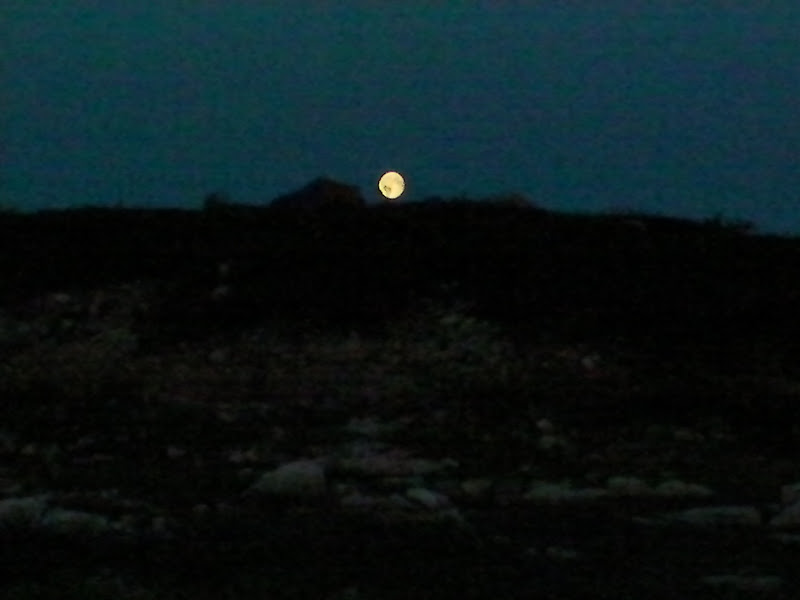
Reaching a sandy beach on the right bank we made the decision to make camp. This was in part because we could not see the next set of rapids in the setting sun (the time must have been 10 or 11 at this point). After a quick dinner we took some photos of the full moon above the tents and then retired for the night.
Warden's Grove
With only about 10km left to our destination we learned that we would not be leaving two days early, but rather on our scheduled flight on July 30th. The next morning we ran the last set of rapids and spent some time where the rapids undercut the cliffs on the right bank. There was an eddy here where we went bathing and watching cliff swallows that had built their nests of clay in the sandstone overhang.

We now had a couple of days to spend at Warden's Grove, but unfortunately neither Taras, nor Nestor recognized the spot from their last trip. The place I had marked on my GPS was a place that reminded them of the campsite, but they remained unconvinced and after phoning the air service, we pushed on down the river about 1 km past the coordinates they gave us.
Over the next afternoon Roman and I tried unsuccessfully to locate the Warden's Grove cabin (it must have been about 700 metres up river from where we ended up searching). It was a disappointment to me not to locate the cabin knowing that I may never have another chance to visit this river. I had read Chris Norment's account of his experiences researching the Harris sparrow from the cabin in his book "Return to Warden's Grove" and had hoped to recognize the places he had described so intimately.
My disappointment was allayed to a large extent when Roman and I were alerted by Taras and Nestor over the walkie-talkie that a bull muskox was on the left shore of the river at the point I now believe must have been Warden's Grove. We paddled up river to within 50 metres of this majestic animal feasting on the shore grasses. He was seemingly unconcerned with our presence as we took videos and pictures from the canoes. This was a highlight of the trip.
The last day on the river was spent fishing, relaxing and sorting out gear for the flight home. The memories of this trip would be mixed. There was adventure for sure and the splendour of the tundra was unforgettable. The physical nature of the trip was satisfying in that I came away with a sense that I could still tackle a trip of this nature. I regret that I was not able to feel a closer bond with those I travelled with. None of us expressed a wish to travel again together.
Monday, September 13, 2010
The Elk River: The Rapids

After Damant Lake, the last of the large lakes on the Elk River, the descent off the Precambrian shield begins in earnest. The elevation at Damant Lake is 390 meters above sea level, and where the Elk River enters the Thelon River the elevation is 300 meters. In the 120 km, therefore, from Damant Lake to Granite Falls (where the two rivers meet),the drop in elevation is 90 meters or 295 feet! Forty meters of that drop occurs in the last 5 km. There was some serious white water paddling to be done.
For our group the rapids presented a particular challenge. None of us was prepared for the what lay ahead, least of all my travelling partners, whom as I have already stated had no white water experience. We agreed after the first set of rapids that we would scout everything and that if any one of us felt uneasy about running we would track or portage.
I have provided as good a description of the rapids as I could from my trip journal on the Wilderness Canoe Association website (http://www.myccr.com/canoedb/routeDetails.php?routeid=876). As the route description notes, there were a few days where river travel was quite difficult and we ended up walking the through the safe water close to shore, a technique called tracking. This was difficult for me because I am not the most agile guy around. All of us found these days strenuous given the amount of hiking we did to scout the river, and given the amount of lifting the fully loaded canoes.
The days of tracking were contrasted with days when we were able to paddle 30 or so km with little difficulty through easy rapids and swifts. By about the 9th day, however, we began to worry whether we would be able to make Warden's Grove, the end point of our trip on the Thelon, by August 30th. This created some pressure to push ourselves when we could and we envisioned having to work this hard for every inch of ground even when we reached the Thelon.
The Dump at the Narrows
The Elk started to get tricky very shortly after leaving Damant Lake. The day we left Damant we were successful in running the class I and the swifts and our confidence was given a boost.
On day two things got somewhat trickier. Taras and I were the first to attempt to run a class I+ set of rapids. We had scouted the rapids and had a pretty good idea of how to approach them with a slight shift to the right after which there was an easy draw to the left. All went according to plan for the first 100 meters; I was in the bow and was able to draw right around the first submerged boulder. As is typical of guys who haven't paddled together before in white water, there were communication problems which in very short order created havoc. Before we knew it, the water was pulling us onto an submerged boulder on our right. My attempted correction, - a draw to the left- without Taras working with me, meant that we broadsided the boulder and were dumped into the river for a 400 meter swim through fast current.
We managed to recover our gear, except for Taras' fishing rod and tackle. And after changing into dry clothes we set out again. Needless to say, we were far more cautious with the rest of the rapids and made sure we tied the gear in the canoes, something we had neglected to do up to this point. In looking back on the incident I made a mental note that it is necessary when canoeing with novices to fully review the role of stern and bow paddlers. People who have only done flat water canoeing are under the impression that steering of the canoe is the job of the sternsman. And in flat water this is the case. But in white water the bowsman often sees obstacles well in advance and acts to correct the course; the sternsman then acts to move the canoe sideways in the direction set from the bow.
Unexpected Guests
On the morning of July 20th, as we ate our breakfast, we were hailed from the river by a pair of paddlers. The canoe was well fitted with deck covers and a spray skirt. The canoeists were Rob Kesselring and his friend Peter. Rob and Peter were attempting to complete a 1400 km trip across the subarctic to Baker Lake. They had to end their trip at Beverley Lake - impressive none-the-less.
The Unmarked Rapids, and Then the Falls
The drop in the last 5 km of the Elk River is about 40 meters. The majority of this drop is through Granite Falls. There is, however, about 2 km of class III+ rapids that are not marked on the topo maps. We wisely pulled out of the river upon hearing the roar and chose to portage this set. It is my opinion that Bill Layman really underestimated this set of rapids in his write up and I am doubtful they could be run in an open canoe. Check them out for yourself below.
Granite Falls is really quite a spectacular piece of real estate. I has 8 or more steps and runs over pink and red granite through a narrow gorge. I have included the video of one of the last steps on this blog. After these falls the Elk joins the flow of the mighty Thelon.
Next: The mighty Thelon - river of fish
Tuesday, September 7, 2010
The Upper Elk River: The Big Lakes
 The Upper Elk river is characterized by several large lakes, the largest being Vermette, Rennie and Damant. The first day out saw us paddling to the northern end of Rennie, stopping where the lake branches to the west and the east. Traversing the inlets and bays of the large lakes meant that we had to check and re-check our position on the topo maps. I was glad that I had pre-loaded the waypoints into my GPS before setting out, when we were in doubt a simple check was all we needed to stay on course.
Rapids Between the lakes
For the next two days we paddled east through Rennie Lake, picking up the Elk river at the narrows between Rennie Lake and Damant Lake. It was at this point that we encountered our first set of rapids; a set of class I and a few swifts. I learned here that my travel companions had little prior experience with white water. Skills that are needed to run rapids safely include being able to, execute special strokes (draw, pry, ferries etc.), "read" the water and wave action to predict the presence of rocks and execute canoe rescues in fast water. My new canoe mates did not have practice with these skills, or any training through courses. I made a note in my journey that, we would need to be careful through the rest of the fast water that we might encounter. Fortunately, the rapids we had just completed were not technical and we were able to make a successful run with the loaded canoes.
Damant Lake
Damant Lake proved to be more confusing than Rennie, given the abundance of bays and inlets. It took us two days to traverse this large lake and we were quite fortunate not to have encountered much by way of head wind. The weather was warm, mainly clear and only moderately windy. It was very fortunate, indeed, that the wind through Damant was at our back, not only were we pushed along with a 2.5 km/hr boost, but the
 wind kept the black flies at bay.
On both of the days on Damant Lake Nestor showed off his fishing prowess. By trolling the large lake on the first day he and Taras were able to catch a couple of nice size
 d lake trout for our dinners. Nestor and I caught arctic greyling on the second afternoon. These we caught in the rapids where the Elk river leaves Damant Lake's north shore.
Bird Life
One of the delights that I appreciated on the large lakes (and throughout the trip) was he abundance of bird life. Birds that we had identified in large numbers up to now included Harris Sparrows, Hooded Mergansers, Lapland Longspurs and Arctic and Common Terns and Thayers Gulls.
On our campsite at the north end of Damant we were treated throughout the evening and next morning to the alarm calls of a pair of nesting Whimbrels (a member of the curlew family).
Whimbrel Video
Next: The Elk River white water. (click to continue)
Subscribe to:
Posts (Atom)